

Cricket Fielding Positions | Cricket Fielding Positions Names | Fielding Positions In Cricket Ground
Overview
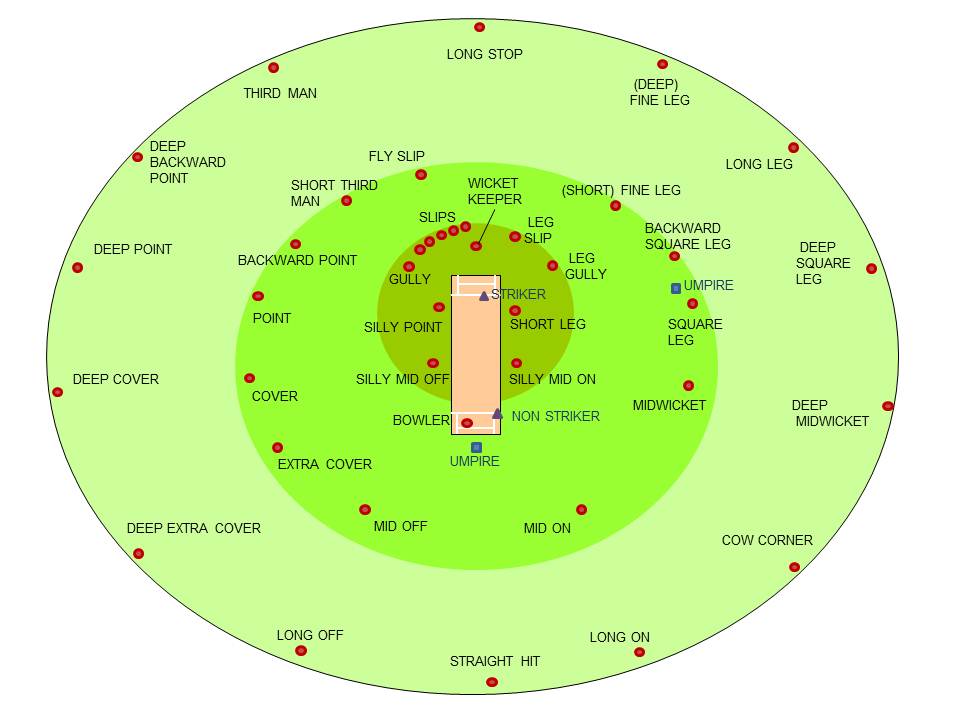
Cricket fielding positions refer to the locations on the field where players are placed to catch the ball, stop runs, and get the opposing team’s players out. The fielding team has 11 players, including the bowler and the wicket-keeper, who work together to defend their team’s score. Each position has its own unique role and requires a specific set of skills, such as throwing, catching, and running. The fielding positions are strategically placed to cover the entire field, with some players positioned close to the batsmen and others farther away. The captain of the fielding team typically decides the positions of the players, taking into account their strengths, weaknesses, and the opposing team’s batting style. The fielding positions can be adjusted during the game to respond to the opposing team’s strategy and to exploit their weaknesses.
The fielding positions are divided into two main categories: the infield and the outfield. The infield includes positions such as the wicket-keeper, slips, gully, point, and cover, which are located close to the batsmen. The outfield includes positions such as mid-off, mid-on, long-off, and long-on, which are located farther away from the batsmen. The fielding team can also have additional players in the outfield, such as deep fine leg and deep square leg, who are positioned near the boundary of the field. The fielding positions are crucial in determining the outcome of the game, as they can help the fielding team to get the opposing team’s players out and restrict their score.
Official dimensions and measurements
The official dimensions and measurements of a cricket field are specified by the International Cricket Council (ICC) and are used in all professional and amateur matches. The field is typically circular or oval in shape, with a diameter of varying size. The pitch, which is the area where the batsmen stand, is located in the center of the field and is 22 yards long and 3.33 yards wide. The pitch has two sets of three stumps, known as wickets, at each end, which are 28 inches tall and 22 inches wide. The boundary of the field is marked by a rope or a line, and the distance from the pitch to the boundary varies depending on the size of the field.
The fielding positions are not specified by the ICC in terms of exact measurements, but rather in terms of their location on the field. For example, the slips are positioned behind the wicket-keeper, while the gully is positioned between the wicket-keeper and the slips. The point and cover are positioned on either side of the pitch, at an angle to the batsmen. The mid-off and mid-on are positioned in front of the pitch, at a distance of varying length from the batsmen. The long-off and long-on are positioned near the boundary of the field, at a distance of varying length from the batsmen. The deep fine leg and deep square leg are positioned near the boundary of the field, at an angle to the batsmen.
Equipment used
The equipment used in cricket fielding positions includes the ball, the bat, the wickets, and the protective gear. The ball is made of leather and cork, and is hard and heavy. The bat is made of wood, and is flat on one side and rounded on the other. The wickets are made of wood, and consist of three stumps and two bails. The protective gear includes a helmet, pads, gloves, and a box, which are worn by the batsmen and the wicket-keeper to protect themselves from the ball. The fielding team also uses a variety of other equipment, such as cones and markers, to mark the positions of the players on the field.
The wicket-keeper and the batsmen wear specialized protective gear, including a helmet, pads, gloves, and a box. The helmet is a hard shell that covers the head and face, while the pads are worn on the legs to protect them from the ball. The gloves are worn on the hands to protect them from the ball and to help the player grip the bat. The box is a hard shell that is worn over the groin area to protect it from the ball. The fielding team also uses a variety of other equipment, such as a first-aid kit and a stretcher, in case of injuries during the game. The equipment used in cricket is an essential part of the game, and is used to protect the players and to ensure their safety during the game.
How the game is played
The game of cricket is played between two teams, each with 11 players. The game is divided into innings, with each team taking turns to bat and bowl. The batting team sends two batsmen onto the field, who take turns to hit the ball bowled by the opposing team’s bowler. The bowling team has 11 players, including the bowler and the wicket-keeper, who work together to get the batsmen out. The fielding positions are strategically placed to cover the entire field, with some players positioned close to the batsmen and others farther away. The fielding team can use a variety of tactics, such as spin bowling and fast bowling, to get the batsmen out.
The game is played in a series of overs, with each over consisting of six balls. The bowler delivers the ball to the batsman, who attempts to hit it with the bat. The batsman can score runs by hitting the ball and running to the opposite end of the pitch, or by hitting boundaries and sixes. A boundary is a shot that reaches the boundary of the field without being touched by any fielder, while a six is a shot that is hit over the boundary of the field without being touched by any fielder. The batting team continues to bat until a certain number of overs have been bowled, or until a certain number of wickets have been taken. The teams then switch roles, with the batting team taking the field and the bowling team taking turns to bat.
Scoring system
The scoring system in cricket is based on the number of runs scored by the batting team. The batting team scores runs by hitting the ball and running to the opposite end of the pitch, or by hitting boundaries and sixes. A single run is scored when the batsmen run to the opposite end of the pitch, while a boundary is a shot that reaches the boundary of the field without being touched by any fielder. A six is a shot that is hit over the boundary of the field without being touched by any fielder. The batting team can also score runs by hitting fours, which are shots that reach the boundary of the field after being touched by a fielder.
The score is displayed on a scoreboard, which shows the number of runs scored by the batting team, as well as the number of wickets taken by the bowling team. The scoreboard also shows the number of overs bowled, as well as the number of balls remaining in the over. The team with the highest score at the end of the game wins, unless the game is a tie, in which case the result is decided by a variety of methods, such as a bowl-out or a super over. The scoring system in cricket is complex, but it is an essential part of the game, and is used to determine the winner of the game.
Key rules and common fouls
The key rules in cricket include the rules of bowling, batting, and fielding. The bowler must deliver the ball with a straight arm, and must not throw the ball. The batsman must not hit the ball twice, and must not obstruct the fielding team. The fielding team must not touch the ball with their hands, unless they are the wicket-keeper, and must not push or block the batsmen. The game is overseen by two umpires, who enforce the rules and make decisions on dismissals and appeals.
Common fouls in cricket include bowling no-balls, which are deliveries that are not bowled with a straight arm, and wides, which are deliveries that are bowled outside the pitch. The batting team can also commit fouls, such as hitting the ball twice, or obstructing the fielding team. The fielding team can also commit fouls, such as touching the ball with their hands, or pushing or blocking the batsmen. If a foul is committed, the umpire can call a no-ball or a wide, or can give a warning to the player. In severe cases, the player can be dismissed or banned from the game. The rules in cricket are complex, but they are an essential part of the game, and are used to ensure fair play and sportsmanship.
Frequently asked questions
One of the most frequently asked questions about cricket fielding positions is what is the role of each position. The wicket-keeper is responsible for standing behind the wickets and catching the ball, while the slips are responsible for catching the ball that is edged by the batsman. The gully is responsible for catching the ball that is hit in the air, while the point and cover are responsible for fielding the ball on the off-side. The mid-off and mid-on are responsible for fielding the ball on the on-side, while the long-off and long-on are responsible for fielding the ball near the boundary.
Another frequently asked question is how the fielding positions are decided. The fielding positions are typically decided by the captain of the fielding team, who takes into account the strengths and weaknesses of the opposing team’s batsmen, as well as the skills and abilities of the fielding team’s players. The captain can also adjust the fielding positions during the game, in response to the opposing team’s strategy and to exploit their weaknesses. The fielding positions can also be adjusted to suit the type of pitch and the weather conditions, with some positions being more effective in certain conditions than others. The fielding positions are a crucial part of the game of cricket, and are used to determine the outcome of the game.
Other frequently asked questions about cricket fielding positions include what is the difference between a slip and a gully, and what is the role of the mid-off and mid-on. The slip is a position that is closer to the wicket-keeper, while the gully is a position that is closer to the point. The mid-off and mid-on are positions that are located on the on-side, and are responsible for fielding the ball that is hit in that direction. The mid-off and mid-on are typically positioned at a distance of varying length from the batsmen, depending on the type of pitch and the weather conditions. The fielding positions in cricket are complex, but they are an essential part of the game, and are used to determine the outcome of the game.





Post a Comment
You must be logged in to post a comment.